Saturday, December 4, 2010

ArtTraveler installs anti-Tea Party collage on his fridge door

I'm thrilled to confess I'm a liberal. There's nothing wrong with the "L" word despite Democrats eschewing same.

In my month-long return to the United States of my origin with fresh eyes this fall and while enjoying a Bohemian oasis of liberalism in one of Charlotte, NC barrios, I bought a few bits and bobs as the Brits say, plus a picture of my son, Josh, and I with our catch from Lake Superior the weekend of his senior exhibition at the University of Minnesota Duluth as he prepared to graduate with a BFA (Bachelors of Fine Arts).

My son's the real deal, an artist, a maestro and like so many artists in the world, an evolving talent. But alas, he is my son, and hence I confess my prejudice.

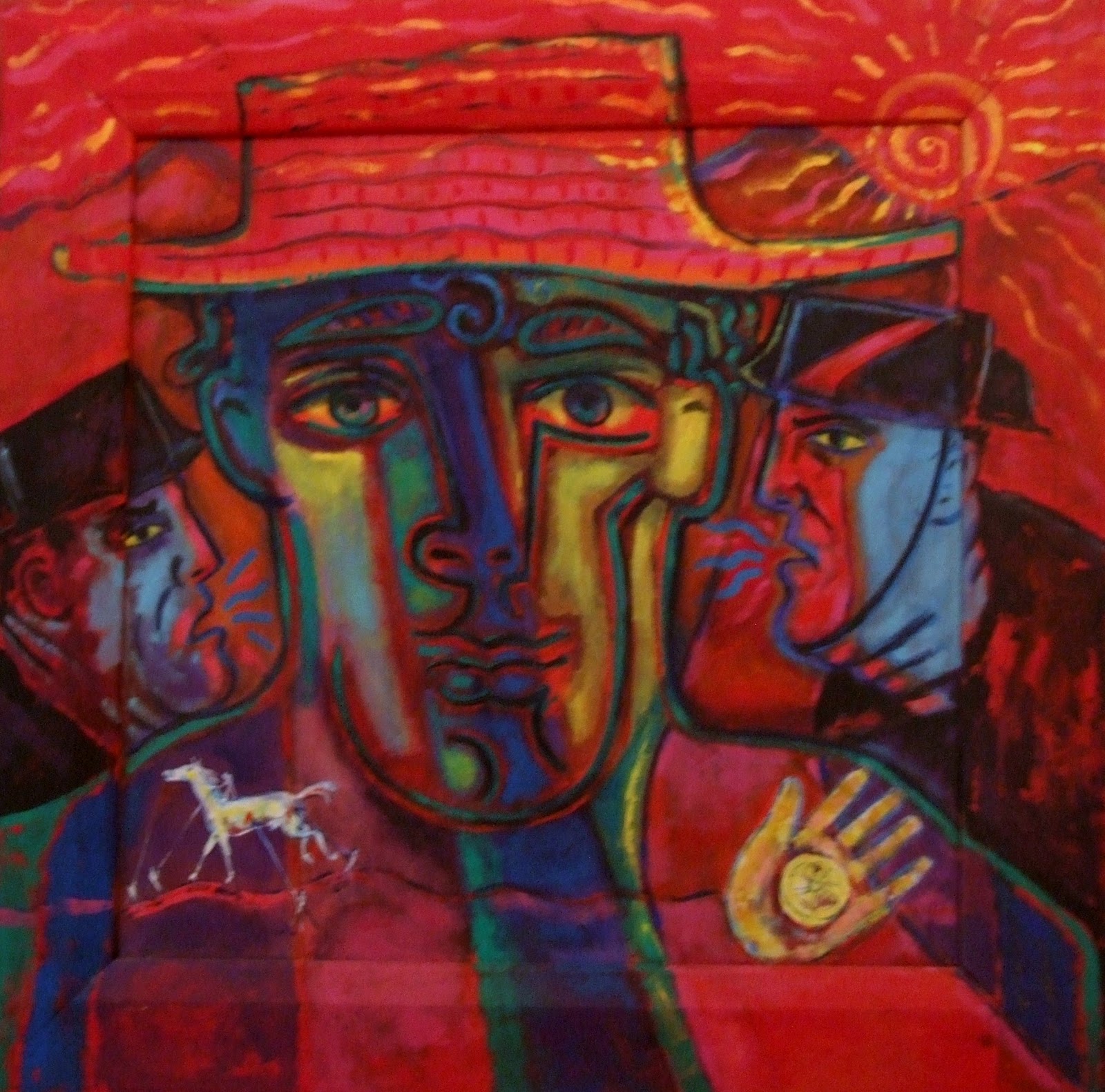
And I also present my Fridge Art, summarising the state of America.

Yeah, get real!

Rock on and practice peace. Check ArtTraveler's videos: http://bit.ly/h1vruw


Stefan, the ArtTraveler (TM)

ArtTraveler's love for Spain pours out in paintings and photography

When walking in the mountains, you come upon ruins everywhere.
This is the first painting I sold. I gave it to our CAT charity (Canillas Animal Trust), which I co-founded with Kate Morris. I painted it quickly (maybe two or three days), almost as a frenetic acrylic sketch. Problem I faced and I still don't know the answer: Did I finish it? I had no foto or model. All in the head. (Acrylic on canvass; 52 cm X 62 cm).
As I walked along the goat trail from Canillas to Competa, a 25-minute journey within oneself, along paths taken by the Moors, perhaps even the Romans, I came upon five men and a live sheep in deep repose (only the sheep was sleeping, looking quite dead), very contented. I photographed them and then over 10 months attempted to recreate the visual impact using pointalism and a few van Gogh-like brush strokes. It's acrylic on canvass, 130 cm X 100 cm.
Competa
I

 I shot these fotos during the past two years observing nature and local religious fiestas. I have many more. These offer a better context about my life here. Nature's a very personal connection. The campesinos in Andalusia, at least in my area of the mountains (Canillas de Albaida and Competa) exhibit a rugged love for the land; the earth is their domain.

Fairly typical scene when walking.


It is what it is.
And vast expanses of nature's pallettes abound
A 15-minute walk from my door, this intact Roman bridge.


A 300-year-old olive tree below Corumbela.
Sign near Torre del Mar marking entrance to moto cemetery.
Somewhere in the mountains.
Man, mule, dog: a common sight.
Atop Bentomiz, the Moorish fortress controlling my area up until about 1487. The Moors first occupied parts of Spain in 711.
This is San Anton, patron saint of animals and also one of two saints most revered by Canillas de Albaida. About 10 village men and women walk in perfect precision in a procession or walk through the main streets of the village as part of the religious fiesta, which includes the local priest blessing animals. You can have a ride by blessing or present your favorite sheep for spiritual renewal, or dog, or cat, mule, burro, bird and on and on.
There's a reason to love Spain.


 I really don't know where this blog's going. I seem visually fixated and for me, that's a normal state of mind. As I said in an earlier post, "Art is a state of mind."

Rock on and practice peace.Also see some of my funky videos: http://bit.ly/h1vruw

Stefan, the ArtTraveler (TM)


ArtTraveler probes neolithic Spanish caves for light, shape, texture and inspiration

This is where the neolithic expanded family met, ate and did whatever.

At the end of last academic year's Spanish 101 class in Competa, our profesora organized a matriculation tour of neolithic caves along the Med at Rincon de la Victoria.

The spectre of dank and dark smells, the obtuse and acutely sharp-edged light formations and the historical context of nomadic cave dwellers moving from one settlement to another, surviving in these domains of the dark, created visions of neo-world fantasies and ghosts of peoples long past--now serving as tour guides.

I share a few of the images I shot whilst in the bowls of Spain's neolithic past.

All fotos by S. van Drake


Rock on and practice peace.

And please check out my funky videos: http://bit.ly/h1vruw

Stefan, the ArtTraveler (TM)


    Friday, December 3, 2010

    ArtTraveler laments Israel's devastating fires and recalls Haifa sunsets

    Before the 1967 war, in 1963, I walked through the Mandelbaum Gates from then West Bank Jordan to East Jerusalem, Israel, through a no-man's land of barbed wire and tank traps, a  wide and deep ditch in the desert that led you along a half-mile walk from an Arab to the Jewish state.

    For two weeks, I worked for food and lodging at a large kibutz above Haifa, awaiting a Turkish freighter that would take me to the island of Rhodes, Greece and then to Pireaus. 

    As I write this, more than 40 people have died in the area where I suspect I picked apples. The whole area is ablaze. There's enough fire and death in the Middle East. 

    I was well received as a Gentile, loved picking apples and experienced the most beautiful sunsets in the world, at least the world I had experience up close and personal at age 19.

    Rock on and practice peace.Please see ArtTraveler's videos: http://bit.ly/h1vruw


    Stefan, The ArtTraveler (TM)

    ArtTraveler revisits old friends in Bavaria, discovering cemetary art

    After not seeing Lothar Heppner and his wife, Mitschi for 26 years, I decided to visit them in Bavaria, about 40 kms outside Munich, and go back to our future, to enjoy the fellowship that never died from our days living and working in Tripoli, Libya, especially our intense times playing music together as the Green Book Band, named after Kadaffi's "green books," (think Mao and Red) detailing the madness of his political thought, which at the time (1977 - 1980) was more than a little influenced by his habit of popping speed. Another story.
    Lothar and Mitschi Heppner

    As I managed to take the last train to Mammendorf from Munich, arriving at 1 a.m. plus or minus, where Lothar and family live, I thought about war, the world wars, about my deceased father, Robert, having fought the Nazis for three and one-half years, in North Africa, up Italy's boot, into France, across France to Germany, and thought about the madness of war.

    I talked to Lothar and Mitschi--dear friends--realizing how our fathers considered each other enemies and how we killed and maimed each other. The futility of war.

    While there a week, I took time to visit a small church cemetery near my hotel. I walked among the stone reminders and images and noted how many families, series of brothers and others, were killed in WWI and WWII. I share some of these images with you:


    Thanks to our reunion, Lothar and I are collaborating on his production of a CD which may include a yet to be written song (my lyrics and his music): "The Last Train to Mammendorf." Here's a foto Lothar took of me at the Mammendorf train station.

    ArtTraveler recreates arrival on the last train to Mammendorf.
    Rock on and practice peace.And check out ArtTraveler's videos: http://bit.ly/h1vruw

    Stefan, the ArtTraveler (TM)

    Thursday, December 2, 2010

    ArtTraveler reveals secret to exorcising possessed paintings

    As a novice painter, exploring the unknown and learning from the masters and those with many years more experience among the living, I found myself a year ago again revisiting a painting in progress I had grown to detest and fear, started in 2005.

    The fear is fear of failure, since I had repeated this ego-destructive gesture with each new pallette and series of futile, ill-conceived brush strokes on this  portrait of some kind of Balkan warlord or genocidal criminal.

    I'm sure I started it on a very bad day when anger and depression merged to give life to this monster.

    At least five times I struggled with it. Nothing worked. I hated it more and more. So, finally, while chipping away at what would be an alabaster cat mask with human lips at Moira Schepel's weekly sculpting class at her villa and studio, I approached professional painter and sculptor  David Graves.

    "Burn it," he said without flinching as he whittled away at a male torso in alabaster. David had obviously been there and done that.

    I did but I wanted to make something of it, a celebration, a kind of purging of evil spirits and record of having made a new beginning by destroying the malignant painting.

    A proper BBQing immediately flashed into view. I share some of my fotos of this exorcism.


    Rock on and practice peace. Also, check out my funky videos: http://bit.ly/h1vruw

    Stefan, the ArtTraveler(TM)

    Wednesday, December 1, 2010

    John Barrett's "Lorca: A Dream of Life" fuses visual, dance, flamenco music with verse

    "The arrest of Tony Camborio" John Barrett 80 cm X 80 cm acrylic on canvass and wood.

    In the black of night on 19 Aug.1936, fascist militia in Granada rounded up about 2,000 suspected leftists, artists, poets, activists, intellectuals from a carefully prepared blacklist and trucked them to a small village outside Granada--Viznar.

    There among them, poet and playright Federico Garcia Lorca, who was shot and killed and buried in a mass grave. It was the start of the Spanish Civil War.

    A couple years ago, authorities claim to have identified this mass grave, but Lorca's only living relative, who resides in the US, refused exhumation and DNA testing.

    Despite an official lid on the past, many elderly Spaniards of the present lived during the civil war or had family members who were killed.

    John Barrett at Canillas opening of "Lorca: A Dream of Life" in August 2009
    All sides and factions committed attrocities, More than 14,000 Catholic clergy were killed along with 14 poets. All this is part of the subterrenean Spanish psyche.

    Into these troubled waters waded John Barrett, then a London free-lance illustrator and for the last decade, senior full-time lecturer at the Institute of Art and Design at Birmingham City University.

    About 20 years ago, as part of his University of Leeds  Masters in Art and Design, John probed deeply into the Spanish psyche through Lorca's poems, exploring them and their metaphors and trying to visually iterpret between Lorca's lines, his subtle meanings, Lorca's and Spain's mythical icons. It became a 15-year project, his Lorca Project.

    John prolifically created about 300 images prepared for two shows. Half the images interpret Lorca's poems from 1919 to 1929, "Lorca: A Dream of Life." The other, yet to be inaugurated, "Lorca: Poet in New York," cover Lorca's works from 1929 to his death in 1936.

    John says he thinks it would ideal to open "Lorca: Poet in New York" in San Francisco or New York, combining drama, dance, flamenco music and his images in a multi-dimensional Lorca Project happening.

    He appreciates that despite an official lid on the past, some Spaniards of the present lived durng those times or had family members killed. All sides and factions committed attrocities, More than 14,000 Catholic clergy were killed along with 14 poets. All this is part of the subterrenean Spanish psyche. .

    John appears a maestro as he employs pastels, pencil, scraper board, paintings in acrylic and water-based inks using bleached technique, a few prints and photos.

    His profound visual quest and prolific production utilising varied media, including creating art books, first became available to the Spanish public in August 2009 during two inaugural exhibitions, one in Canillas de Albaida, the other in Competa.These local governments fully supported each show, volunteering space.

    John Barrett's intellect, his own intimate journey into the soul of Spain's perhaps best known and most certainly, most martyred poet, Federico Garcia Lorca, grabs you.

    John Barret at his Canillas de Albaida opening.
    The genesis behind each image is an "immense amount of drawing before the final illustration....dry runs often determine the medium."

     Afterwards (by Lorca)

    The  children gaze
    at a distant spot.

    The lamps are put out.
    Some blind girls ask questions of the moon
    and spirals of weeping
    rise through the air.


    The mountains gaze
    at a distant spot.


    Barrett's dyptch: "Song of a Descending Day" at his Competa, Spain "Lorca: A Drem of Peace" show.
    John describes his work: "Many of the poetic words are interwoven into the fabric of the image, thereby building a rich dialogue between line, texture, space and form are intimately connected to the content of the words written by the poet and thereby the interplay of text and image is crucial to the way that the image is read."

     "I needed to see the whole story of Lorca's birth, his life, visit these places and see the village where he died,"John adds.

    His successful Leeds Universitty master's in art and design Lorca Project catapulted him from free-lance London illustrator (for 20 years and quite successful but what a rat race!) to senior full-time lecturer at the Institute of Art and Design at Birmingham City University.

    Through the Lorca Project John sought to "expand illustration techniques and themes and perhaps move away from constraints of commercial illustration."

    The Lorca Project compelled him to appreciate "incredible metaphors often used as a surrealist technique of juxtaposing absolute disconnected meanings creating a third meaning, which dislocates the reader." Hence, at least 12 huge sketch books, each a work of art in itself, complete with detailed annotations and hundreds of drawings, many worth framing.

    Few artists have entered upon such a journey to visually intepret the poems of an iconic poet. HIs Lorca Project is unprecedented.

    Open any of his scores of sketch books and you'll see colourful and detailed sketches, notes, quotes from his poems, page after page. it sometimes took days and weeks to develop a single concept that John thought worked for Lorca's verse and when he finally decided on it, the construction of the work seemed explosive, fast,  like magic, like pent up adrenalized intensity, something erupting from deep inside him and flowing onto paper or canvass or wood panel.
    "It is true" by Barrett, acrylic on wood, 42 cm X 60 cm

    "There's a mixture of spontenaiety and also it's very calculated because of my experience working tight deadlines as an illustrator; most images are small compared to painters, so I come with lots and lots of various pieces of a puzzle," he says.

    For John, "...colour, line, texture, space an form are intimately connected to the content of the words written by the poet and thereby the interplay of texta nd image is crucial to the way that the image is read."

    Like other artists, John connects the musical rhythm of the verse with the ultimate visual image.

    John, who is developing a Lorca Project website, says Lorca primarily concerned himself with themes of fate and death in the lives of country people and gypsies in Andalusia. "His early poetry portrays elemental human passions and emphasizes the interpretation of dreams and reality in their lives."
    "Arc of Moons" by Barrett, acrylic, 80 cm X 80 cm


    Saying Goodbye (Lorca)


    I'll be saying goodbye
    at the crossroads,
    Heading off down that road
    through my soul.


    I'll arouse reminiscences,
    stir up mean hours.
    I'll arrive at the garden spot
    in my song (my white song),
    and I'll start to shiver and shake
    like the morning star.
                                                                                                           
    Detail from large dyptch: "Song of a Descending Day"

    De Profundis
    by Lorca


    Three hundred lovers
    are asleep forever
    beneath the dry earth.
    andalucia has
    long, red coloured roads.
    Cordoba, green olive trees
    for placing a hundred crosses
    to remember them.
    Those hundred lovers
    are asleep forever.


    The Moon Appears (Lorca)

    When the moon comes out
    bells fade out

    and the paths are                                                       
    impenetrable.

    When the moon comes out,
    the sea covers the earth
    and the heart feels like an island
    in the infinite.

    Nobody eats oranges
    under the full moon.
    We need to eat
    green fruit and ice.

    When the moon comes out
    with one hundred faces equal
    silver coins
    sob away in pockets.


    Rock on and practice peace and love. Also, check out ArtTraveler's videos: http://bit.ly/h1vruw


    Stefan, the ArtTraveler(TM)